Oberlin Information and Literature
|
Oberlin Information and Literature |
|
"Oberlin is peculiar in that which is good." |
|
Founded in 1833 as a utopian religious community, Oberlin, Ohio has a long and distinguished history of visionary activism and progressive work for peaceful social change. From the very beginning, Oberlinians advocated the peaceful abolition of slavery as well as gender and racial equality, being the first coeducational college and the first integrated college in the United States. |
|
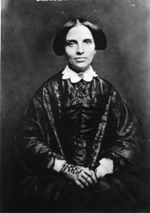
Mary Caroline Rudd OC1841, the first co-ed (Courtesy of the Oberlin College Archives) |
|
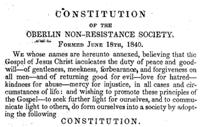
Early student and faculty groups such as the Oberlin Non-Resistance Society, Oberlin Peace Society, and Oberlin Peace League emphasized the spiritual foundation of their non-violence movements. (See the documents below.) Other early Oberlinians were among those who attended the Paris International Peace Convention of 1849 and who advocated the formation of organizations similar to the United Nations and World Court � almost 100 years before those bodies were established. |
|
|
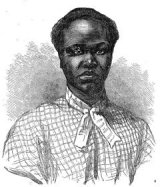
Lewis Tappan, an original benefactor of the college, was closely involved with the freeing of the Amistad captives. One of them, a girl named Margru, later returned to the United States (the only one of the captives to do so). She studied at Oberlin for three years before returning to Africa in 1849 to become headmistress of a missionary school in present day Sierra Leone. |
|
Margru in 1849 (American School for the Deaf) |
|
John Price, a young fugitive slave, was kidnapped near Oberlin by bounty hunters early on September 13, 1858 and taken to the nearby town of Wellington for transport back to Kentucky. |
|
|
When news of the incident reached Oberlin, a large crowd � blacks and whites, slave and free, students, faculty, farmers, clerks, and lawyers � rushed to Wellington, freed him in defiance of the Fugitive Slave Law, and guaranteed his safe passage to Canada. The Oberlin-Wellington Rescue and the subsequent trial of the rescuers attracted national attention and became a cause cel�bre of the Abolitionist movement. Two of the rescuers and a third Oberlin resident went on to participate in John Brown's Raid on Harper's Ferry. Many other fugitive slaves passed through Oberlin without incident on the Underground Railroad. |
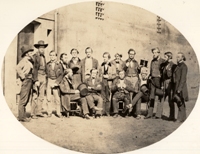
Rescuers at the Cleveland jail (Oberlin College Archives) |
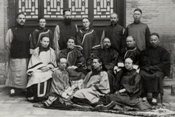
Oberlin missionaries of 1893 (Oberlin College Archives) |
|
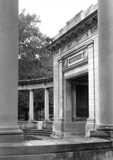
The arch pictured here was erected in memory of the Oberlin missionaries who, while providing education, medical care, and the gospel in Shansi, China, were martyred in the Boxer Rebellion of 1900. Oberlinians were not deterred by this setback and, to this day, Oberlin Shansi continues to promote educational and community projects in Asia. |
|
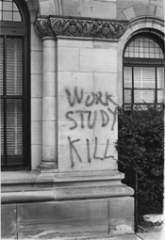
In 1930, Oberlin students foresaw the gathering clouds of war over Europe and established the second Oberlin Peace Society, to which half of the student body belonged. Together with college president Ernest Hatch Wilkins, they valiantly tried throughout that decade to prevent the most terrible of 20th century wars. Wilkins remarked, "What is the use of giving four years of laborious and expensive education to these fine young men and women, if their lives are presently to be shattered, in one way or another, by war and the consequences of war?" His vision of a formal academic program in peace studies remained unfulfilled for more than seventy years. (Oberlin College Archives) |
|
|
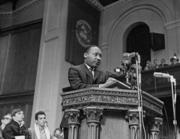
Vernon Johns, an Oberlin graduate, is sometimes called the father of the American civil rights movement. He was certainly one of its early pioneers and prepared the way for his successor at the Dexter Avenue Baptist Church, Rev. Martin Luther King. King himself visited the college four times and exhorted the students to "remain awake during a great revolution" in his 1965 commencement address. (Oberlin College Archives) |
|
On one of those visits, in February 1957, Rev. King met James Lawson, who was in the second semester of a master's degree program at Oberlin. King was immediately impressed and told him, "Don't wait! Come now! We don't have anyone like you down [South]. We need you right now. Please don't delay. Come as quickly as you can. We really need you." Lawson did come, led the Nashville lunch counter sit-ins, helped found the Student Nonviolent Coordinating Committee (SNCC), helped organize the Freedom Rides and the 1963 March on Washington, and, sadly, was the one who invited King to Memphis in April 1968. |

(Oberlin College Archives) |
Protest against the war in Vietnam was strong on the Oberlin campus during the latter half of the 1960s. Student action went beyond mere protest on several occasions, including the successful disruption of the draft deferment test in 1966, Air Force recruiting in 1967, and Marine recruiting in 1969. In October, 1967, a crowd of over 100 protesters endured tear gas and fire hoses when they detained a Navy recruiter in his car for four hours, resulting in the suspension of recruitment on campus. |
|
During the 1980s, while the United States was supporting brutal right-wing regimes in Central America and denying refugee status to those fleeing the bloodshed, a network of compassionate individuals and churches known as the Overground Railroad provided transportation and shelter to those refugees while their requests for asylum in Canada were being processed. Oberlin hosted 28 such Guatemalan and Salvadoran refugees. |
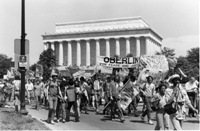
(Oberlin College Archives) |

|
In January 2009, in response to Immigration and Customs Enforcement raids that resulted in the deportation of eight local restaurant workers as illegal aliens, the Oberlin City Council passed a resolution guaranteeing equal access to city services without regard to citizenship and stating that it shall be the general practice of City of Oberlin not to inquire about the immigration status of crime victims, witnesses, or others who call or approach city staff seeking assistance. |
|
In March 2009 the Oberlin Faculty Senate approved the college's first formal academic program in Peace and Conflict Studies. Students in this interdisciplinary concentration study the factors that lead to human conflict and aggression, examine levels of conflict, explore the links between social/environmental issues and violent conflict, and augment intellectual study with experiences outside the classroom. |
|
───── The revolution that Reverend King spoke of is not over yet, and such visionary activism is needed once again to face a new wave of growing nationalism and militarism. |
◄ LINKS ►
Oberlin College
City of Oberlin
O.H.I.O.
E.O.G.

The following material is unabridged and free.
There is no copyright to worry about.
We hope you are inspired!
|
Constitution of the Oberlin Nonresistance Society |
complete |
complete |
|
This student organization, established in 1840, was influenced by William Lloyd Garrison's New-England Nonresistance Society. Though its ideals were lofty and its theology sound, it appears to have been short lived. The society was denounced by Charles Finney and the college faculty and ignored by the Oberlin Evangelist, the college newspaper of the day. |
|
Constitution of the Oberlin Peace Society of 1843 |
complete |
complete |
|
This was the college faculty's response to the Non-Resistance Society. It is a more conservative and less eloquent statement that questioned whether all war is sinful. Although this society also appears to have been short lived, it did send Amasa Walker as a delegate to the 1843 World's Peace Convention in London. |
|
Constitution of the Oberlin Peace League |
complete |
complete |
|
This group was founded in 1850 amidst the optimism of the international peace conferences held in London, Brussels, Paris, Frankfort, and again in London. It was more of a community organization than the previous two societies and had ties to other organizations such as the Lorain County Peace Society, the Ohio State Peace Society, and the American National League of Universal Brotherhood. Abolition and the Civil war eventually swallowed up all of these efforts. |
|
The Bible Against War |
by section |
complete |
complete |
|
Amos Dresser was a missionary, lecturer, pastor, Oberlin resident, part-time cobbler, and one of the �Lane Rebels� who studied at Oberlin College. He was very active in the abolitionist and peace movements of his day and was, at one point, whipped in Nashville for distributing anti-slavery literature. He published this book in 1849, in which he demonstrates that the wars of the Old Testament were not God's original plan for the Jewish people and provides a detailed analysis of Romans chapter 13. |